Arkansas


1946-50 Razorbacks
(Authentic Reproduction)


Arkansas has been an enthusiastic football state for as long as most followers can remember. Nicknamed the Cardinals, it took a comment by head coach Hugo Bezdek in 1909 to give them a name that fills true fans with pride though it is often a stimulus for derisive comment to some others. Noting that his squad had “played like a wild band of razorback hogs”, the name was immediately adopted and through the years, the famous “calling of the hogs” cheer has become immediately identified with the Arkansas football program. Early tutelage came from College Football Hall Of Fame Coach Francis “Close The Gates Of Mercy” Schmidt who built an impressive record between 1922 and ’28 before gaining greater glory at TCU and Ohio State. When Fred Thomsen took the reins in 1929, his teams became known as “The Passing Porkers”. Thomsen saw little sense in plunging for half a yard when he could pass for it! This made for exciting and at times, frustrating football but he also brought Arkansas its first Southwest Conference Championship and developed the school’s first All American. Amid fan disenchantment, Thomsen entered the military service after a 3-7 1941 and though the campaign was in full swing to bring in a “name coach”, everyone understood that this wouldn’t happen until World War II had passed. During the War, though it appeared that the Razorback coaching situation was in flux, it was actually handled by long-time, capable Arkansas men and both remained tied to the program for decades. George Cole had been a quarterback at U of A in the 1920’s and was a Thomsen assistant. On short notice he took the head job for 1942 and matched his former head coach’s 3-7 mark and then he was activated for military service. Glen Rose, a former Razorback receiver and assistant coach remained on the staff but it was difficult to otherwise fill the available coaching positions. Cole did manage to hire John “Bud” Tomlin from an Oklahoma high school and when Cole entered the service, Tomlin steered the ship in 1943. Rose took over in ’44 and stayed until the end of the War. While Arkansas had survived the War years, Cole returned and then gave  decades of service to his school as an assistant and trusted “right hand” to five head coaches including Frank Broyles. Cole eventually took the Athletic Director’s position from 1967 until his retirement in 1973.


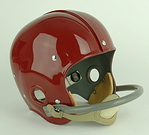
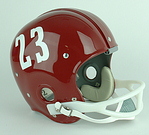
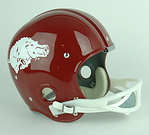
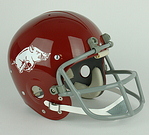
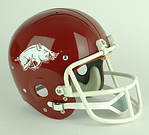
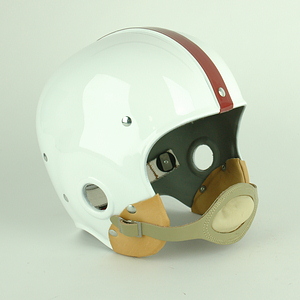
Some realistic alumni and supporters understood that it was time for Arkansas to step up and make a commitment to improve its entire athletic structure. The University Of Texas had refused to play the Hogs at Fayetteville, insisting instead that their games be played in Little Rock. Fearing that the entire SWC would make the same demand, it was time to insure that the University’s facilities were brought up to standard and that a known coach was hired. That coach was John Barnhill who had distinguished himself as the line coach under General Robert Neyland at Tennessee. The powerful Vols were known for their line play and Barnhill was a hot commodity. When Neyland entered active service during World War II, Barnhill was the interim head coach and in four years put up a terrific 31-4-2 mark with trips to the Sugar and Rose Bowls. Rose, ever loyal to Arkansas, willingly gave up the head coaching position to coach basketball at Stephen F. Austin College and returned to coach U of A basketball from 1952 through ’66. On September 1, 1946, Barnhill introduced the vaunted Tennessee Single Wing offense, introduced a Riddell white plastic RT helmet with a one-inch red center stripe, and then viewed practice. For him it was the equivalent of finding money on the sidewalk because on the field was Clyde “Smackover” Scott. Scott had been a genuine high school hero in his hometown of Smackover, Arkansas, recognized state-wide for his exploits in 1942. With the War raging, he joined the Navy and was assigned to Annapolis where he starred on Navy’s number-two ranked squad in 1944 and 1945. A victim of love and romance, Scott met the 1945 reigning Miss Arkansas as she traveled east for the Miss America contest and it was love at first sight. As 1946 progressed, he resigned from the Academy and married his dream girl, and within days was lined up in the Arkansas backfield. With Barnhill’s philosophy based upon defense, field position, and making sure all of the state’s best players stayed at home, Scott’s presence was a great boost to the program. Barnhill’s boys won the “right games” in ’46 and their 6-3-1 record tied for the SWC title, putting them into the Cotton Bowl against LSU and their famed QB Y.A. Tittle. The 0-0 tie was considered a win in Fayetteville and with John Hoffman, Leon “Muscles” Campbell, Mel McGaha, and Scott returning for 1947, everyone was disappointed in the 5-4-1 mark. With a post-War proliferation of bowl contests, this still got the Hogs into the Dixie Bowl where they defeated William And Mary 21-19. Heading into 1948, Scott was the key to the Hogs season, one that included the opening of War Memorial Stadium. He was a two-time All SWC choice, primarily as a DB and return man in ’46, and he defeated world record holder Bill Porter in the 110 high hurdles. In the 1948 Olympic Games, Porter would nose out Scott for the gold medal but “the fastest football player in the country” despite injury was Arkansas’ first three-time All Conference pick and an All American. A member of The College Football Hall Of Fame and as the first and only player to have his Arkansas number retired, injuries limited Scott’s play in the pros although he was a key to the defensive backfield for the 1952 NFL Champion Detroit Lions after serving three seasons with the Eagles. Unfortunately, the available talent could do no better than 5-5. Campbell’s backup John Hoffman was a key player at three positions for the Bears between ’49 and 1956. Despite what most boosters saw as a solid core of players, Barnhill’s wins were not adding up and Arkansas was certainly not one of the SWC powers. Switching to the T-Formation for 1949, primarily to quell his critics, scrapping the antiquated Single Wing would take advantage of the Hogs most acclaimed sophomore class. Dave “Hawg” Hanner, Fred Williams, and George “Pat” Summerall were outstanding line prospects. If nothing else, Arkansas’ reputation for playing rough and tumble ball was upheld by way of an official censure from the conference. Unfortunately, Campbell was injured and this limited the offense, with the team competing well when he was healthy enough to be on the field. Geno Mazzanti whose younger brothers would play for the Hogs years later, filled in and then played 1950 with the Colts while end Bobby Hix would get a year with the Eagles. When the season ended once more at 5-5, “Muscles” Campbell moved on to enjoy a six year pro career with three teams, often excelling when his knee was strong and Barnhill stepped down as coach. With ongoing health problems and the belief that he did not have the full support of the state, he remained as AD. Clyde Scott’s tenure with the Eagles raised interest in the professional game and there was a call for a “sophisticated pro attack.” With the Eagles as World Champions and their coach Greasy Neale seen as the “reigning genius” Barnhill brought in Neale’s assistant coach Otis Douglas, believing that he would either do very well or fail badly which would in either case, unite the populace in the belief that they should support the program as it was, or find a coach all could agree would be acceptable to the numerous arguing factions.


Vowing to “beat those Texas teams” proved to be a burden Douglas was unable to accomplish. A tackle at William And Mary, he went into coaching after graduation and became Akron’s head coach in 1941 and ’42. He became an assistant coach, team trainer, and emergency service active player for the Eagles, jumping in at tackle when needed between 1946 and 1949. In whatever spare time he had, he also ran the Drexel University program. A large, affable man, Douglas knew his X’s and O’s but treated his collegiate players as most coaches treated the pros. Discipline was lax or absent and as future Bears’ standout Fred Williams said later, “We didn’t win many games but we didn’t lose any parties!” If there is an answer to the query “How can Fred Williams, Pat Summerall, Hawg Hanner, Bob Griffin, Lew Carpenter, and Lamar McHan all play together, have pro careers that totaled more than sixty seasons, and hardly win?” the absence of solid assistants that taught basic skills and the lack of discipline would provide an explanation. The team was sorely lacking in fundamental techniques and instead of having a high level of conditioning, Douglas would most often place his largest players on the field, trying to copy the pro recipe of size and strength which did not work well in the lean-and-mean SWC. 1950 was a 2-8 season and the 5-5 of 1951 was marked by ongoing inconsistency. For the 1951 season only, Douglas removed the red center stripe from the helmets, and outfitted the team in leather headgear. The ’51 team in retrospect was incredible if one considers future accomplishments: Lew Carpenter, 1953-’63 with the Lions, Browns, and Packers as an outstanding flanker, end, and two-way back; Dave Hanner, a key anchor at DT for Lombardi’s Packer squads, playing at Green Bay from 1952 through ’64; Bob Griffn, an excellent LB with the Rams from 1952 until completing his pro career in St. Louis in ’61; Pat Summerall, remembered best for his game-saving kicking with the Giants but an effective DE with the Lions and Chicago Cardinals prior to that and of course, for decades, a highly respected sportscaster; “Fat” Fred Williams was an indispensable member of the Bears offensive line from 1952 through ’63 and retired after playing 1964 with the Redskins; Lamar McHan, the Chicago Cardinals 1954 number one draft choice spent ten seasons with four teams in a starting and back-up role. With a lack of depth and an inability for the Hogs to play true platoon football when the manpower shortages of the Korean War demanded a brief return to that system, Douglas of course was seen as an underachiever.

If interested in any of these Razorback helmets please click on the photos below.